Japanese Researchers Shatter Data Speed Records with Standard Fiber

Researchers in Japan have demonstrated a monumental leap in data transmission, achieving speeds that make current consumer internet connections look utterly archaic. A team from the National Institute of Information and Communications Technology (NICT), in collaboration with Sumitomo Electric and European partners, successfully transmitted data at a staggering 1.02 petabits per second. What makes this achievement so significant isn’t just the raw speed. It’s the fact that it was accomplished using an optical fiber cable with a standard diameter, signaling a future where network capacity can be massively expanded without the colossal expense and disruption of replacing the foundational infrastructure already crisscrossing the globe.
A Leap in Core Technology
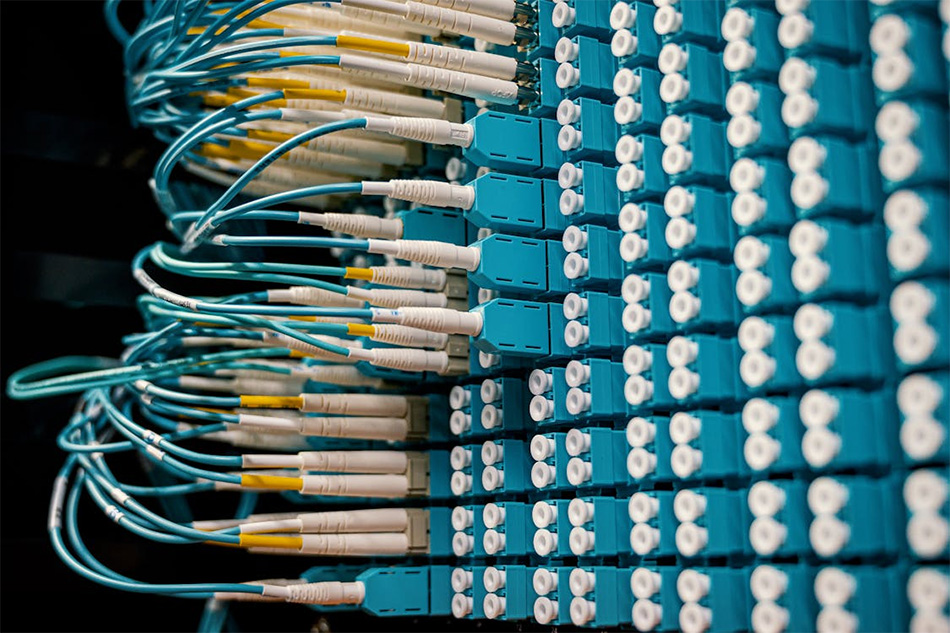
The breakthrough hinges on a cleverly designed 19-core optical fiber. While maintaining the standard 0.125 mm cladding diameter of typical single-core fibers, this new cable packs nineteen distinct pathways for light into the same physical space. This multi-core approach is the key. It allows for a dramatic multiplication of data-carrying capacity while ensuring the new fiber remains compatible with existing network hardware and deployment systems. This test marks the very first time a petabit-class signal has been successfully sent over a distance exceeding 1,000 kilometers using a fiber of standard dimensions, setting a new world record for the capacity-distance product at an incredible 1.86 exabits per second-kilometer. It’s a fundamental rethinking of how much data can be squeezed through a single glass thread.
Simulating a Transcontinental Link
To validate the technology’s potential for long-haul networks, the experiment was anything but simple. The team simulated a vast distance by looping the signal 21 times through an 86.1-kilometer span of the innovative fiber, culminating in a total transmission distance of 1,808 kilometers. Sophisticated amplifiers, meticulously tuned to operate across both the C and L wavelength bands for all 19 cores, were required to boost the signal at every pass. The system leveraged 180 different wavelengths, each modulated with 16QAM, to handle the immense volume of parallel data streams. After the journey, a multi-channel receiver using MIMO digital signal processing was essential to untangle and accurately read the massive influx of information, proving the system’s coherence and reliability.
Putting Petabits in Perspective

The sheer scale of 1.02 petabits per second is difficult to grasp. It is equivalent to 1,020,000,000 megabits per second (Mbps). When compared to the average US broadband speed of roughly 290 Mbps in early 2025, this new record is more than 3.5 million times faster. Such a leap forward represents a paradigm shift in thinking about network capacity. Instead of being constrained by the need for more fiber or wider cables—costly propositions that require extensive construction—this innovation shows a path toward amplifying the potential of the infrastructure already in place. It’s a testament to engineering that avoids brute force solutions in favor of elegant, high-density efficiency.
The results, presented at the Optical Fiber Communication Conference (OFC) 2025, offer a clear glimpse into the future of global backbone networks. While this technology won’t be appearing in homes overnight, it addresses the relentlessly growing demand for data head-on. The research proves that the standard-sized fiber optic cables buried under streets and oceans still possess enormous untapped potential. The next phase of development will focus on refining amplifier efficiency and signal processing to bring this laboratory marvel closer to practical, real-world deployment.